Centered Remainder Representation for Ring Buffer Correction in System-Level Code
Abstract
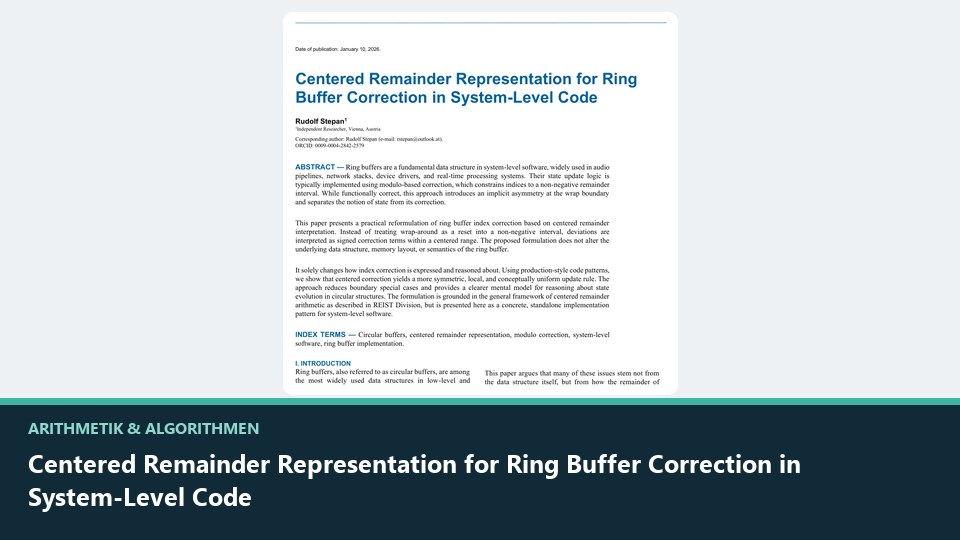
Ring buffers are a fundamental data structure in system-level software, widely used in audio pipelines, network stacks, device drivers, and real-time processing systems. Their state update logic is typically implemented using modulo-based correction, which constrains indices to a non-negative remainder interval. While functionally correct, this approach introduces an implicit asymmetry at the wrap boundary and separates the notion of state from its correction. This paper presents a practical reformulation of ring buffer index correction based on centered remainder interpretation. Instead of treating wrap-around as a reset into a non-negative interval, deviations are interpreted as signed correction terms within a centered range. The proposed formulation does not alter the underlying data structure, memory layout, or semantics of the ring buffer. It solely changes how index correction is expressed and reasoned about. Using production-style code patterns, we show that centered correction yields a more symmetric, local, and conceptually uniform update rule. The approach reduces boundary special cases and provides a clearer mental model for reasoning about state evolution in circular structures. The formulation is grounded in the general framework of centered remainder arithmetic as described in REIST Division, but is presented here as a concrete, standalone implementation pattern for system-level software.
Citation
Stepan, R. (2026). Centered Remainder Representation for Ring Buffer Correction. Zenodo. https://doi.org/10.5281/zenodo.18206445
Interactive Demo
Links & Registries
Version Notes
- Version: 1.0
- Last updated: 2025
Katalogeintrag & Dokumentfassungen
Beschreibt Ringpuffer-Korrekturen mit einer zentrierten Restdarstellung. Der Fokus liegt auf Zustandsführung und Wrap-around-Logik in systemnaher Software.