Persistent Modular Phase-State Updates for GFSK Waveform Generation: A Reproducible WSJT-X Case Study
Abstract
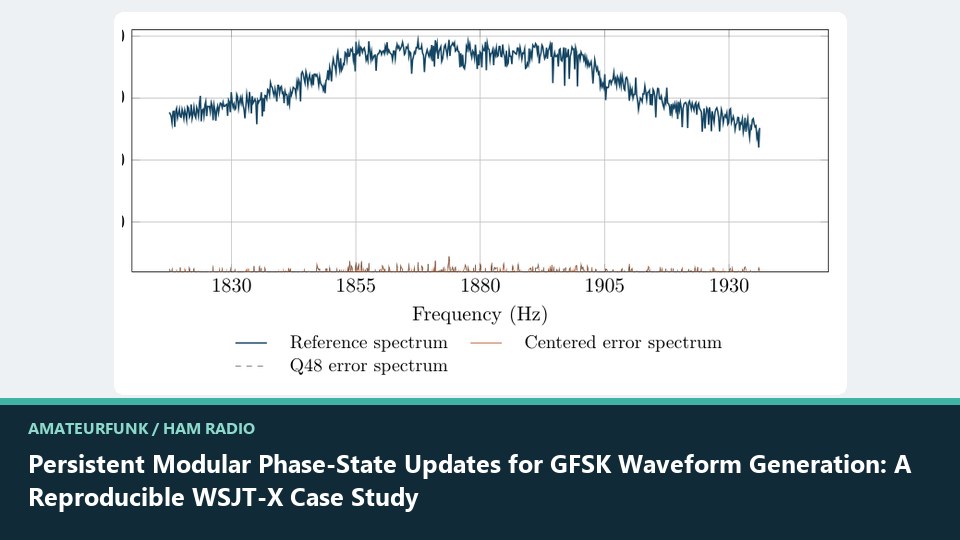
A digital oscillator need not keep track of completed turns. It can store phase within one period and correct that state after each frequency step. This paper examines how that familiar principle affects the GFSK waveform generators of a WSJT-X fork. The centered formulation is motivated by Stepan’s REIST-Division manuscript. We establish the conditions under which one correction suffices in binary64 arithmetic, then compare centered and positive states with general remainder, masked correction, Q48 fixed point, unbounded accumulation and two block-prefix implementations. On an Intel Core i9-14900K, the general-remainder implementation takes about 2.6 times as long as centered correction on the selected performance core and 4.4–5.2 times as long on the selected efficiency core. Positive and centered states cost nearly the same. The tested fixed-point and prefix variants are slower. Numerical checks cover encoded frames, long sequences, interval boundaries and digital spectra. The practical limit is modest: the already optimized waveform generator accounts for 2.13–3.73% of the measured file-decoder time. Even removing that work entirely would increase total processing speed by only 2.17–3.87%, if all other work stayed constant. The study therefore contributes a reproducible comparison of phase representations and their application cost. It establishes neither an exclusive advantage of centered arithmetic nor improved radio sensitivity. Source hashes, raw measurements and analysis scripts accompany both language editions.
Context
Reproduzierbare WSJT-X-Fallstudie zu begrenzten Phasenzuständen in GFSK-Generatoren. Zentrierte und positive Zustände werden mit allgemeiner Restbildung, Festkomma- und Präfixvarianten verglichen; Rechenkernunterschiede werden nicht als End-to-End-Gewinn des gesamten Funkprogramms ausgegeben.